
Tests de réducteurs de précision pour les cobots: Réducteurs pour VR, Entraînements harmoniques & the Sub-1 Arcmin Challenge
The collaborative robot market will reach $54.9 billion by 2026. At its core: precision reducers where sub-1 arcminute backlash is no longer a premium spec — it’s a baseline requirement. Here’s how to test them correctly.
Why Cobot Reducer Testing Has Become Critical in 2026
The industrial robot speed reducer market is experiencing explosive growth driven by the expansion of collaborative robots (cobots) in manufacturing, medical, and logistics applications. Key market drivers include:
🔩 RV (Rotary Vector) Reducers
RV reducers use a two-stage design: an input spur gear stage followed by a cycloidal gear stage. They offer very high torque density and rigidity, making them the preferred choice for heavy-payload cobot joints (shoulder, elbow).
Critical Test Parameters
| Contrecoup | <1 arcmin (premium) |
| Torsional Stiffness | N·m/arcmin |
| Erreur de transmission | Peak-to-peak, arcmin |
| Efficacité | ≥85% at rated load |
| Bruit | ≤65 dB(UN) at 100 RPM |
| Rated Torque | Jusqu'à 6,000 N·m |
Typical cobot applications: FANUC M-series, ABB IRB, payload ≥10 kg
⚙️ Harmonic Drive (Wave Generator)
Harmonic drives (also called strain wave gearing) use three components: a wave generator, flexspline, and circular spline. They achieve extremely high reduction ratios (50:1–320:1) in a compact form, with near-zero backlash — ideal for lightweight cobots.
Critical Test Parameters
| Contrecoup | <0.5 arcmin (near-zero) |
| Erreur de transmission | ±0.5 arcmin peak |
| Torsional Stiffness | N·m/arcmin (lower than RV) |
| Efficacité | 70–80% (lower than RV) |
| Max Input Speed | Jusqu'à 14,000 RPM |
| Rated Torque | Jusqu'à 500 N·m |
Typical cobot applications: Universal Robots UR series, lightweight arms, payload <10 kg
What a Precision Reducer Test Bench Must Measure
A test bench for cobot-grade reducers must go far beyond simple torque and speed measurement. The sub-1 arcmin precision requirement demands a specialized measurement chain.
Essential Measurement Capabilities
- Backlash measurement: Angular measurement resolution ≤0.01 arcmin
- Transmission error (TE): Dual high-resolution encoders (≥21-bit) on input/output
- Torsional stiffness curve: Load-vs-angular-deflection across full torque range
- Efficiency mapping: Input vs output power at multiple speeds and loads
- Thermal testing: Continuous duty at rated torque with temperature monitoring
- Nvh / vibration: Accelerometers on housing, especially under low-speed ripple
- Life / endurance: Accelerated wear testing per ISO 9283
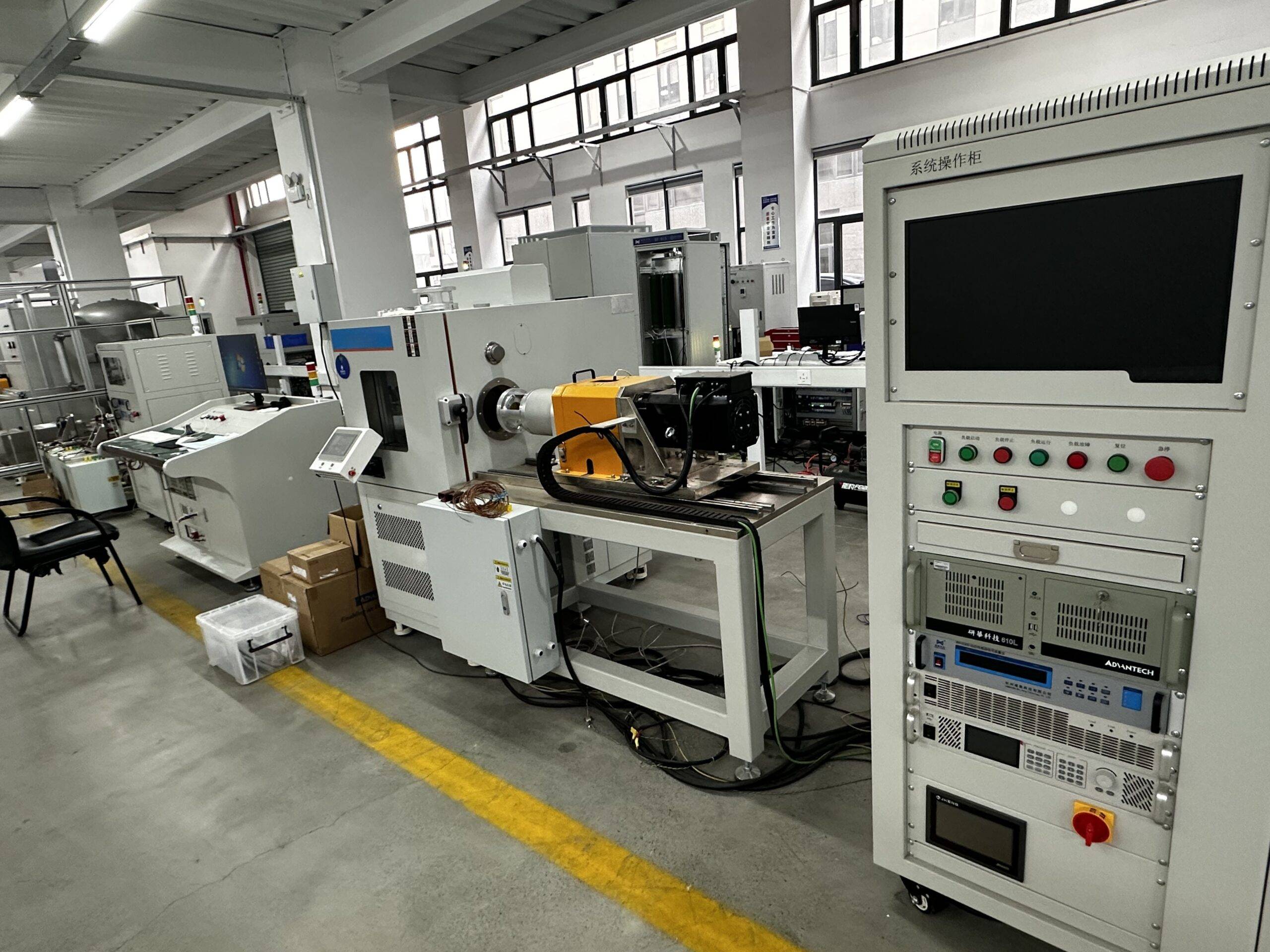
RV Reducer vs Harmonic Drive: Test Bench Requirements
| Test Parameter | Réducteur pour VR | Harmonic Drive |
|---|---|---|
| Backlash Target | <1 arcmin | <0.5 arcmin |
| Encoder Resolution Needed | ≥20-bit | ≥21-bit |
| Torque Accuracy Required | ±0.1% | ±0.05% |
| Max Input Speed | Jusqu'à 3,000 RPM | Jusqu'à 14,000 RPM |
| Stiffness Measurement | Critical | Important |
| Recommended Dynamometer | Hysteresis or Magnetic Powder | Hystérèse (zero-speed capable) |
Build a Sub-Arcminute Reducer Test System
EconoTest supplies complete RV reducer and harmonic drive test benches with integrated high-resolution encoder systems. Request a specification tailored to your cobot application.