
这 曳引机试验台 is an advanced testing solution designed for evaluating the performance and durability of traction motors and their associated mechanical systems. Specifically engineered to test a wide range of electric drive systems, this test bench facilitates the analysis of traction machines used in electric vehicles, railway systems, and industrial applications. Through a combination of mechanical load testing, heat dissipation analysis, and endurance testing, the traction machine test bench ensures that motors perform to the highest standards of efficiency, 安全, and reliability.
This state-of-the-art system allows for both real-time monitoring and precise control of operational conditions, such as load, 温度, and mechanical stresses. Equipped with advanced sensors and CAN-based data acquisition systems, the traction machine test bench provides accurate data for performance verification, design improvements, and regulatory compliance.
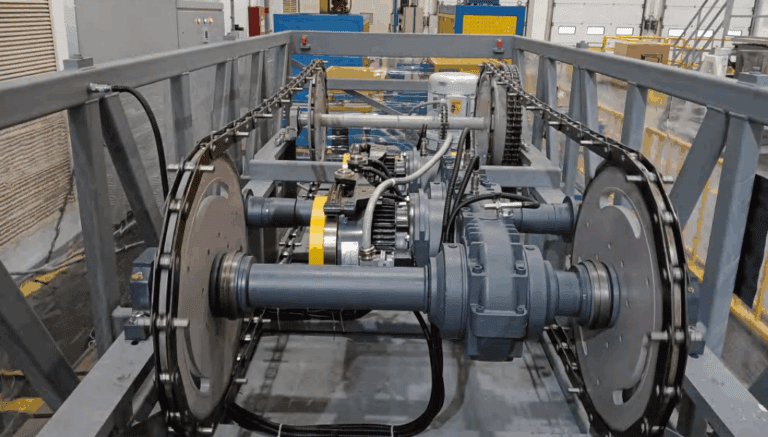
曳引机试验台: Comprehensive Validation for Elevator Drive Systems
我们的 曳引机试验台 is the specialized solution for evaluating the performance and safety of lift and escalator drive units. It is engineered to test geared reduction motors, permanent magnet gearless synchronous motors, and automatic escalator/walkway drives. The system covers full performance testing, load simulation, and critical **UCMP (Unintended Car Movement Protection) brake response time measurement**.
Core Architecture & High-Efficiency Advantages
High Stability & Control
- System Composition: Comprised of a scalable fixed base platform, a dedicated power load simulation system, a measurement/control system, and a feedback system.
- Control Protocol: Centralized control utilizes **CAN bus (TCP/IP)** for high-speed communication, integrated power regulation, and load management.
- 高可靠性: Features high stability, high repeatability, 高精度, and high automation, making it ideal for R&D centers and professional laboratories.
Efficiency & Data Management
- 能量再生: Utilizes an **efficient feedback system** (能量再生) to recycle energy during braking or load simulation, significantly reducing operational costs. (Referencing the common feature of energy-efficient test benches).
- Comprehensive Protection: Provides full-range safety protection, data acquisition, processing, and query functions integrated into one system.
- Data Integrity: Ensures high measurement accuracy and repeatability, meeting stringent R&D and quality assurance standards.
Full-Range Performance & Safety Testing
The test bench provides a complete suite of validation tests for elevator drive systems, ensuring compliance and peak performance:
| Function Classification | Specific Test Mode | Regulatory & Engineering Objective |
|---|---|---|
| Main Performance Tests | 空载测试, load performance test, 温升测试, and durability test. | Verifies rated parameters, power consumption, and long-term thermal stability. |
| Load Simulation | Simulates the actual operating conditions of the traction machine pulling the elevator car/counterweight. | Evaluates system response and efficiency under realistic duty cycles (例如。, accelerating, lifting, descending). |
| Safety Critical Testing (Brakes) | Measurement of the brake's dynamic response time (UCMP testing). | Essential for compliance with global elevator safety standards (例如。, EN 81-20/50 and relevant local codes). |
Monitoring and Analysis Features (Derived from similar systems)
The system provides real-time monitoring comparable to other high-end test solutions:
- Measurement Parameters: Continuous measurement of Input/Output Torque, 速度, and Power.
- Thermal Channels: Multi-point temperature monitoring (environment, winding, 油, cooling water) with alarm and protection functions.
- NVH分析: Integrated sensors for measuring Vibration and Noise levels during operation.
- Automated Control: Supports both automatic program control and manual/semi-automatic load adjustments.
应用领域
Electric Vehicle Manufacturers:
Perfect for automakers designing and testing electric propulsion systems for electric and hybrid vehicles.Railway Systems:
Ideal for testing traction motors used in trains and other rail transport systems.Industrial Applications:
Useful for testing traction systems in various industrial equipment that require robust drive systems.