
Banco de teste de eixo E vs banco de teste de trem de força: O que você precisa?
A technical guide for EV engineers and procurement teams choosing between focused E-Axle testing and complete powertrain integration testing.
Principais conclusões
- An e-axle test bench validates the integrated electric drive unit (motor + inversor + gearbox) directly at its output shafts.
- A powertrain test bench validates the complete driveline, including hub-coupled wheel loads, 2WD/4WD configurations and VIL/ADAS scenarios.
- EconoTest reference capability: e-axle projects up to 450 kW, 20,000 RPM e 5,000 Nm.
- Choose by validation scope: component-level development favours the e-axle bench; vehicle-level integration favours the powertrain bench.
Overview: Two Approaches to EV Powertrain Testing
As electric vehicle technology matures, test bench requirements have grown more specialized. Engineers working on EV and hybrid powertrain development increasingly need to choose between two distinct testing configurations:
⚡ E-Axle Test Bench
Tests the integrated motor + inversor + gearbox unit as a complete electric axle assembly
🔧 Powertrain Test Bench
Tests the complete drive system including battery emulation, eletrônica de potência, and multi-axis coupling
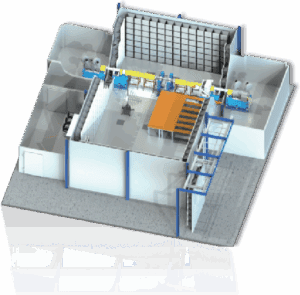
⚡ E-Axle Test Bench
What It Tests
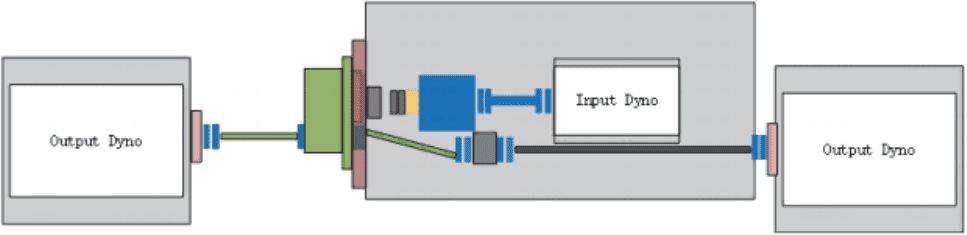
An E-Axle (Electric Axle) integrates the electric motor, power inverter, and reduction gearbox into a single compact unit. The E-Axle test bench validates this assembly as a system — measuring efficiency, thermal behavior, NVH (noise/vibration/harshness), and durability under real driving profiles.
Key Capabilities
| Power Range | 50–500+ kW |
| Speed Range | 0–20,000 RPM (motor shaft) |
| Voltage | 400V / 800V systems |
| Test Types | Mapa de eficiência, thermal, NVH, resistência |
| DUT Interface | Flanged or wheel-hub coupling |
Best For
- OEM EV development teams validating e-axle designs
- Tier-1 suppliers verifying integrated axle performance
- Efficiency mapping for homologation
- NVH and durability testing under real drive cycles
🔧 Powertrain Test Bench
What It Tests
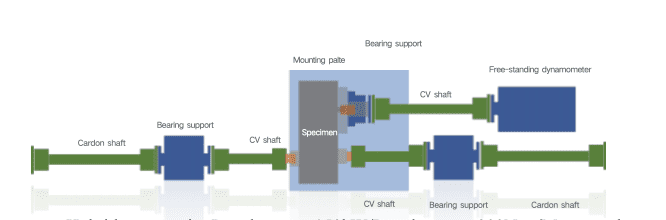
A Powertrain Test Bench tests the complete drive system — from battery pack (or battery emulator) through power electronics and motor, down to the wheels or drivetrain output. It simulates real vehicle load conditions using advanced drive cycle simulation and vehicle dynamics models.
Key Capabilities
| Power Range | 100–1,000+ kW |
| Test Scope | Full system (battery to wheel) |
| Drive Cycles | WLTP, NEDC, custom profiles |
| Battery Emulation | ✅ Available |
| HIL Integration | ✅ Hardware-in-the-Loop capable |
Best For
- Full-vehicle system integration testing
- Simulação do ciclo de condução (WLTP, NEDC)
- Hybrid and multi-motor AWD systems
- Battery + inversor + motor combined validation
E-Axle vs Powertrain Test Bench: Side-by-Side Comparison
| Criteria | ⚡ E-Axle Test Bench | 🔧 Powertrain Test Bench |
|---|---|---|
| Test Scope | E-motor + inversor + gearbox | Complete vehicle drivetrain |
| Typical Power | 50–500 kW | 100–1,000+ kW |
| Battery Emulation | Opcional | ✅ Standard |
| Drive Cycle Sim. | Limited | ✅ Full WLTP/NEDC |
| Teste de NVH | ✅ Optimized | Basic |
| Setup Complexity | Medium | Alto |
| Typical Application | Component R&D, Tier-1 suppliers | OEM system integration |
| Relative Cost | $ – $$ | $$$ – $$$$ |
How to Decide: Key Questions to Ask
Choose E-Axle Bench if…
- You're a Tier-1 e-axle supplier
- Need detailed NVH characterization
- Testing single-axle EV components
- Budget is a key consideration
Choose Powertrain Bench if…
- You're an OEM validating complete vehicles
- Need full drive cycle simulation
- Testing AWD or multi-motor systems
- Battery-to-wheel integration required
Consider Both if…
- Running R&D and system integration
- Testing multiple vehicle platforms
- Large-scale EV development program
Not Sure Which Test Bench Fits Your Project?
EconoTest engineers will analyze your test requirements and recommend the optimal configuration. Contact us for a free technical consultation.
Perguntas frequentes
What does an e-axle test bench measure?
NVH, eficiência, thermal behaviour, EMC/EMI and durability of the integrated electric drive unit, including e-motor, inverter and transmission as one assembly.
When do I need a hub-coupled powertrain bench instead?
When validating the complete driveline with wheel-side loads, 2WD or 4WD operation, or vehicle-in-the-loop (VIL) and ADAS scenarios.
What speed and torque can EconoTest e-axle benches reach?
Reference projects run at 450 kW, 20,000 RPM e 5,000 Nm. Standard models offer 10,000–15,000 RPM with 250–300 kW and dual high/low-speed outputs.
Can one bench cover both e-axle and powertrain testing?
Modular benches can be reconfigured between tasks, but most labs use separate, task-optimized benches to avoid changeover downtime.
Do these benches support EMC testing?
Sim. E-drive and e-axle EMC testing per CISPR 25 and ISO 11452-2 is available from 20 kW up to 700 kW systems.