
วิธีการเลือกระหว่าง Eddy Current, ฮิสเทรีซีส & Magnetic Powder Dynamometers
A complete technical comparison to help engineers select the right dynamometer for motor, อีวี, และการทดสอบระบบส่งกำลัง.
ประเด็นสำคัญ
- Eddy current dynamometers excel at high speed (ขึ้นไป 50,000 รอบต่อนาที) but cannot produce braking torque at zero speed.
- Hysteresis dynamometers deliver full torque from 0 RPM — the right choice for small motors and locked-rotor tests (0.1–30 นิวตันเมตร).
- Magnetic powder dynamometers provide high, smooth torque at low speed (2–2,000 นิวตันเมตร, typically up to 5,000 รอบต่อนาที).
- Match the dynamometer to your torque–speed envelope and accuracy target (±0.2%–±0.5% FS) rather than choosing by price.
Introduction: Why Dynamometer Type Matters
Choosing the wrong dynamometer type is one of the most costly mistakes in motor and powertrain testing. Each technology—eddy current, ฮิสเทรีซีส, and magnetic powder—operates on fundamentally different physical principles, which directly determines the test parameters it can accurately measure, its response speed, and its suitability for specific applications.
This guide provides a technical breakdown of all three types to help engineers and procurement teams make the right decision for their specific test requirements.
High-power, ช่วงความเร็วกว้าง
Precision, low-speed torque
Zero-speed, factory EOL testing
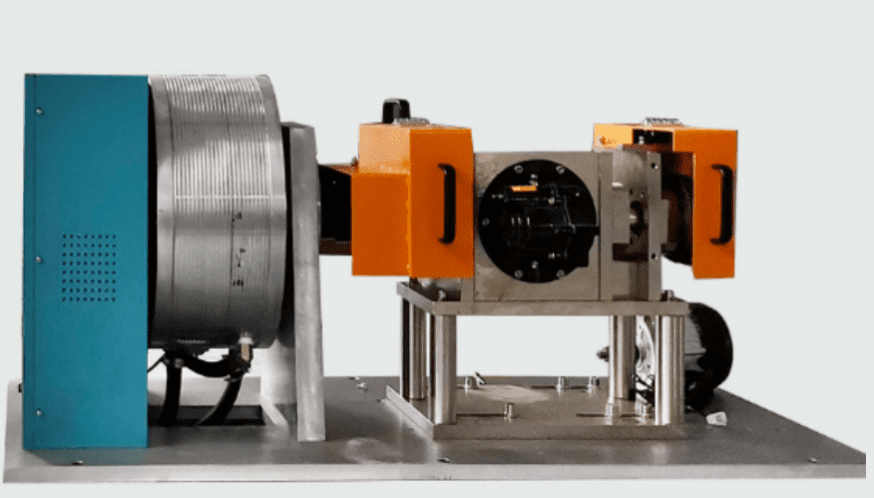
⚡ Eddy Current Dynamometer
How It Works
Eddy current dynamometers use electromagnetic induction to generate braking torque. A conductive rotor spins within a magnetic field produced by DC coils; induced currents create opposing forces that resist rotation. Torque is controlled by adjusting field current.
Key Specifications
| Speed Range | 100–15,000+ RPM |
| Power Absorption | ขึ้นไป 2,000+ กิโลวัตต์ |
| Torque Accuracy | ±0.2–0.5% |
| Response Time | Fast (10–100 ms) |
| Zero-Speed Torque | ❌ Not available |
Best Applications
- EV motor & E-Axle performance testing
- High-power industrial motor validation
- Automotive powertrain & การทดสอบการส่งผ่าน
- Efficiency mapping across wide speed/load range
🔵 Hysteresis Dynamometer
How It Works
Hysteresis dynamometers use a slotted stator and a hysteresis disk rotor. As the rotor passes through alternating magnetic poles, the material’s hysteresis loss generates heat and braking torque. Critically, torque is speed-independent — making it ideal for near-zero-speed testing.
Key Specifications
| Speed Range | 0–30,000+ RPM |
| Power Absorption | ขึ้นไป 200 กิโลวัตต์ (typical) |
| Torque Accuracy | ±0.1–0.25% (ความแม่นยำสูง) |
| Response Time | Very fast (<10 ms) |
| Zero-Speed Torque | ✅ Full rated torque |
Best Applications
- Small motor R&D and precision testing
- Servo motor and stepper motor evaluation
- High-speed spindle and dental drill testing
- Harmonic drive and precision reducer testing
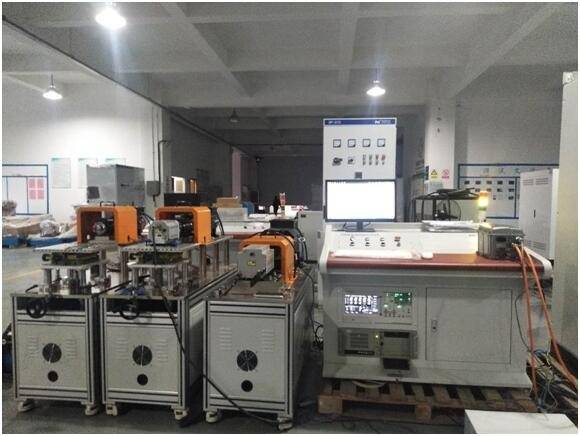
🟠 Magnetic Powder Dynamometer
How It Works
Magnetic powder dynamometers use ferromagnetic powder between rotor and stator. When the coil is energized, powder particles align and form chains, creating shear force that resists rotation. Torque is nearly linearly proportional to excitation current, enabling precise control including at zero speed.
Key Specifications
| Speed Range | 0–3,000 RPM |
| Power Absorption | <50 กิโลวัตต์ (continuous) |
| Torque Linearity | ยอดเยี่ยม (<1% hysteresis error) |
| Response Time | Moderate (100–500 ms) |
| Zero-Speed Torque | ✅ Full rated torque at stall |
Best Applications
- Motor production line end-of-line testing
- Torque sensor calibration
- Conveyor motor and pump motor testing
- Low to medium speed applications (<3,000 รอบต่อนาที)
Quick Comparison: All Three Types at a Glance
| Feature | ⚡ Eddy Current | 🔵 Hysteresis | 🟠 Magnetic Powder |
|---|---|---|---|
| Speed Range | 100–15,000+ RPM | 0–30,000+ RPM | 0–3,000 RPM |
| Max Power | 2,000+ กิโลวัตต์ | <200 กิโลวัตต์ | <50 กิโลวัตต์ |
| Torque Accuracy | ±0.2–0.5% | ±0.1–0.25% | <1% |
| Zero-Speed Torque | ❌ | ✅ | ✅ |
| Response Speed | Fast (10–100ms) | Very fast (<10ms) | Moderate |
| ระบายความร้อน | Water cooled | Air/water | Air cooled |
| ดีที่สุดสำหรับ | อีวี / ยานยนต์ / High-power | Servo / Precision / ความเร็วสูง | EOL / Calibration / ความเร็วต่ำ |
Which Dynamometer is Right for You?
Choose Eddy Current if:
- Testing EV motors or E-Axles
- Power requirements exceed 100 กิโลวัตต์
- Wide speed range needed
- Automotive powertrain or transmission
Choose Hysteresis if:
- Testing servo motors or small motors
- Need high-speed range (>10,000 รอบต่อนาที)
- Precision torque at near-zero speed
- ร&D lab applications
Choose Magnetic Powder if:
- Production line end-of-line (EOL)
- Stall torque testing required
- Low power (<50 กิโลวัตต์)
- Torque sensor calibration
Need Help Selecting the Right Dynamometer?
EconoTest engineers help you match the right technology to your test requirements. Get a customized recommendation within 24 ชั่วโมง.
คำถามที่พบบ่อย
Can an eddy current dynamometer hold torque at zero speed?
เลขที่. Eddy current braking requires rotation. For zero-speed or locked-rotor torque testing, use a hysteresis or magnetic powder dynamometer instead.
What torque range do magnetic powder dynamometers cover?
EconoTest ECF series covers 2 ถึง 2,000 Nm with air or water cooling, at speeds typically up to 5,000 RPM — ideal for servo motors, geared motors and gearboxes.
Which dynamometer suits high-speed e-motor testing?
Eddy current models (ซีรีย์ ECW, ขึ้นไป 50,000 รอบต่อนาที) or dedicated high-speed motor test benches reaching 100,000 รอบต่อนาที.
What accuracy can I expect from these dynamometers?
Torque accuracy ranges from ±0.2% to ±0.5% of full scale depending on the series and frame size.
Can different dynamometer types be combined in one test bench?
ใช่. Multi-dynamometer solutions pair hysteresis, eddy current and powder brakes on one platform to cover a wide torque–speed range.